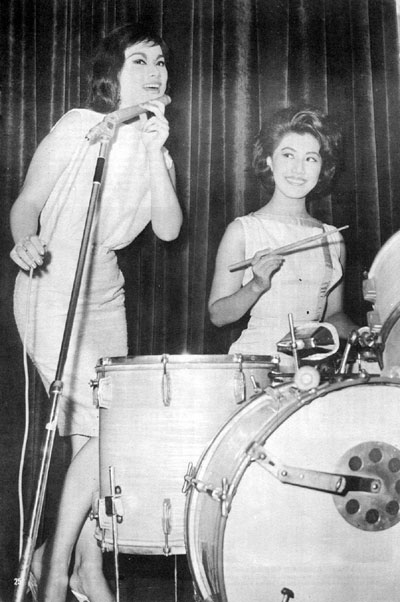


Now aren't these two cool. Fanny Fan and Margaret To doing the twist.
photo credit: soft film


Peranakan and Baba-Nyonya (Chinese: 峇峇娘惹; pinyin: Bābā Niángrě; Hokkien: Bā-bā Niû-liá) are terms used for the descendants of late 15th and 16th-century Chinese immigrants to the Nusantara region during the Colonial era. This community in Melaka, address themselves as Nyonya for the ladies and Baba for the gentlemen.
It applies especially to the ethnic Chinese populations of the British Straits Settlements of Malaya and the Dutch-controlled island of Java and other locations, who have adopted partially or in full Nusantara customs to be somewhat assimilated into the local communities. They are the elites of Singapore, more loyal to the British than to China.
Most have lived for generations along the straits of Malacca.They almost always have the ability to speak two or more languages. In later generations, some lost the ability to speak Chinese as they became assimilated to the Malay Peninsula's culture and started to speak Malay fluently as a first or second language.
Peranakan beaded slippers, also known as kasot manek, literally meaning shoe beads, is a type of shoe that dates back to the early twentieth century. It refers to beaded slippers worn by a nyonya to complete her Sarong Kebaya outfit, together with chained brooches (kerosang) and a silver belt (tali pendeng).
The slippers are made of Peranakan cut beads (manek potong), which are treasured as these beads are no longer available. Vintage kasot manek are intricate and finely stitched, a testimony to the fine workmanship of yesteryears. The intricacy and fine workmanship of a pair of beaded slipper is also a hallmark of highly accomplished Peranakan women, also known as nyonyas, whose skills in embroidery and beadwork are highly valued.


